How Your Law Firm Gets Proven Maps Visibility in 2026
Key takeaway: For Texas law firms, Maps visibility is not a vanity metric; it is a trust and intake channel that can drive calls, form fills, and consultations when prospects are comparing firms in Dallas, Dallas County, and nearby Texas ZIP codes.
Cost signal: Google still relies on relevance, distance, and prominence, so the practical job is to make your Business Profile, website, reviews, and service-area pages tell one consistent local story.
Action point: A compliant Google Business Profile matters because attorney advertising rules in Texas still prohibit misleading claims and require accurate identification of the responsible lawyer and primary practice location.
Risk note: Reviews help law firms stand out in Maps, but they must be gathered and answered without incentives, overpromising, or any disclosure of confidential case facts.
Planning cue: Dallas County visibility is strengthened by specific local service pages, ZIP-code targeting, and internal links that reinforce the same geography you show in Maps.
Bottom line: Public AI chats and prompt logs now belong in the same risk conversation as intake scripts and engagement letters, because Texas ethics guidance warns that confidential information can be exposed through generative AI tools.
For a law firm, “Maps visibility” is never just about being found. It is about being found by the right person, at the right moment, with enough trust to generate a call or consultation. In high-stakes legal searches, prospective clients often open Google Maps before they open a website. They want a nearby firm, a credible office, a clear practice focus, and signs that the firm actually serves the matter they are facing. That makes local visibility a business-development issue and a confidence issue at the same time.
In Dallas, Dallas County, and the surrounding Texas markets, that dynamic becomes even more important because the searcher is usually stressed, time-sensitive, and comparison-shopping across several firms. A law firm that aligns its Google Business Profile, local pages, reviews, and intake language tends to look more established than one that treats Maps as an isolated listing. Google’s own guidance says local results are driven mainly by relevance, distance, and prominence[1], so the path to better visibility is to strengthen each of those inputs without making unsupported claims.
There is also a timely compliance layer. Texas ethics guidance now makes it harder to separate marketing from risk management, because public AI tools can expose confidential information if staff or clients paste sensitive facts into them. That means a modern law-firm visibility strategy has to include profile accuracy, compliant advertising language, and a practical AI and intake policy that protects privilege while supporting conversion. The firms that handle those pieces together usually present better in Maps and in client conversations.
Below is a practical framework for building proven Maps visibility without drifting into hype, misleading advertising, or confidentiality mistakes.
Why Maps Visibility Matters More for Texas Law Firms Right Now
Maps visibility matters because the first search result is not always the first real decision. A prospective client may search from a phone, scan the top map pack, read a few reviews, and decide whether to call before they ever reach the website. For a law firm, that path is especially important because the decision is emotionally loaded and usually tied to an urgent need: a dispute, a lawsuit, a regulatory problem, or a business contract issue that cannot wait. Visibility in Maps therefore works as a conversion shortcut, not just a discovery channel.
That is why the right metric is not “traffic” in the abstract. It is contact behavior: clicks to call, direction requests, consultation forms, and qualified intake conversations. If your Google Business Profile is healthy, your location data is correct, and your service footprint matches the way clients actually hire you, you are more likely to turn search intent into a meaningful inquiry. Google states that a Business Profile can help people find a business on Maps and Search and build trust, and that complete and accurate information is more likely to appear in local results. Those are foundational signals for law firms that depend on local credibility. See Google Business Profile help[2] and local ranking guidance[1].
Why the first call matters
For Dallas-based firms, the geography matters because legal services are still local even when the matter is regional. A client in 75201 may not want a generic statewide result if the issue is tied to a Dallas courthouse, a Dallas business, or a Dallas-area office visit. The same is true across the broader Texas footprint, where a firm might also serve 77001, 78201, 78701, 79401, and nearby ZIP codes. The objective is not to claim every market; it is to show a realistic local footprint that matches actual service capacity and client expectations.
That alignment also improves trust. When the profile, website, and intake process all say the same thing about who you are, what you do, and where you serve, the firm feels organized and reliable. In legal marketing, that consistency matters as much as raw ranking because clients often infer competence from clarity. A firm that looks precise is often perceived as safer to contact.
Put simply, Maps visibility for a law firm is a business-development asset that sits at the intersection of local SEO, reputation, and compliance. The firms that treat it that way are better positioned to convert searches into signed matters.
The Local Ranking Signals That Still Drive Law Firm Maps Results
Google is unusually direct about the core mechanics of local ranking: results are mainly based on relevance, distance, and prominence. That framework is simple enough to explain to a partner and useful enough to guide a real marketing plan. Relevance is about whether your firm matches the searcher’s need. Distance is about how close the searcher is to your office or service area. Prominence is about how well known and trusted the business appears online. Google’s guidance makes clear that you cannot control distance completely, so the real levers are relevance and prominence.
Relevance starts with the Business Profile itself. The firm name should match real-world branding, the primary category should be specific and accurate, and service areas should reflect the places the firm genuinely serves. Google says categories should be specific and representative, not used like keyword stuffing. That is especially important for law firms, because a profile that tries to be everything to everyone often becomes less credible and less compliant. If your firm is primarily a litigation practice, the profile should make that obvious; if your office focuses on business law, personal injury, or family law, the profile should say so in plain language.
How to reduce call friction
Prominence is broader. It includes reviews, links from other websites, branded search demand, and general local authority. A firm that earns mention in local directories, bar-related references, local business citations, and quality publications usually has a better chance of appearing as a trusted result. Google also notes that complete and accurate information can improve local visibility, so even basic cleanup work matters. A wrong phone number, mismatched hours, or inconsistent address formatting can weaken the credibility of the whole profile.
What you should not do is overstate what Maps can guarantee. No source can promise a specific ranking position, and Google does not publish the full formula. The point is to improve the inputs you can influence. If the business details are correct, the category is precise, the service area is accurate, and the brand has earned visible trust, the firm is usually better positioned to compete in the map pack across Dallas County and adjacent Texas markets.
A useful way to think about this is that Maps rewards firms that look like the clear answer to a local legal question. The profile should tell Google who you are, tell the client why you fit, and tell both parties that the firm is real, nearby, and active.
Build a Google Business Profile That Matches Texas Attorney Advertising Rules
For a law firm, Google Business Profile optimization has to happen inside the boundaries of Texas attorney advertising rules. That does not mean the profile should be timid. It means every field should be truthful, consistent, and supportable. Google says the business name should match real-world signage, stationery, and branding, and Texas Rule 7.01 prohibits false or misleading communications about a lawyer’s services. Those two standards fit together neatly: the profile should identify the firm the way it actually presents itself in the world, not the way a marketer wishes it looked in a keyword report.
Start with the basics: exact business name, accurate phone number, office hours, office address if clients meet there, and a primary category that reflects the firm’s real practice. If the office is a service-area business or hybrid setup, use the service-area controls carefully and only within the actual geography you serve. Google says service areas can be set by city or ZIP code, and it allows up to 20 service areas. That gives enough flexibility to cover Dallas, Dallas County, and a realistic set of Texas ZIP codes without pretending to serve every market in the state. See Google’s service-area guidance[3].
How to reduce call friction
The content itself should also stay disciplined. Avoid claims that sound like guarantees, unsupported comparisons, or superiority statements that cannot be documented. In Texas, Rule 7.02(a) requires a legal-services advertisement to identify the responsible lawyer and the lawyer’s primary practice location, and the advertising review framework exists because legal marketing can mislead quickly when it becomes too aggressive. The safer approach is plain-language practice descriptions, clear office information, and photos that make the firm recognizable rather than flashy.
“relevance, distance, and prominence”
Google Business Profile Help
That quote captures the strategic reality: the profile is not a billboard; it is a structured trust signal. A photo of the office exterior, a reception area, team headshots, and a few practical images of the workspace can make the business feel more real without crossing into exaggeration. Q&A entries should answer common questions in a straightforward way and should not overstate case outcomes or imply specialization you cannot support.
After the profile is cleaned up, the website and engagement materials should match it. If the profile says the firm serves Dallas and nearby Texas ZIP codes, the website should say the same. If the intake script says the office is by appointment only, the profile should not imply walk-ins. That consistency matters because clients notice it instantly, and Google’s systems are built to reward coherence between the profile and the broader web presence.
| Visibility lever | Why it matters | Compliance watchout |
|---|---|---|
| Exact business name, category, phone, hours | Improves relevance and helps the profile look complete and trustworthy. | Must match real-world branding and avoid misleading claims. |
| Service area by city or ZIP code | Signals the geography you actually serve in Dallas County and across Texas. | Do not overstate coverage or imply a physical presence where none exists. |
| Photos and office details | Builds legitimacy and helps searchers recognize the firm quickly. | Avoid images that suggest capabilities, offices, or results you do not have. |
| Practice descriptions and Q&A | Clarifies the legal services you offer and reduces confusion. | Keep language truthful, supportable, and free of guaranteed outcomes. |
| Website/profile consistency | Reinforces brand trust and improves local relevance signals. | All channels should align with Rule 7.01 and Rule 7.02 expectations. |
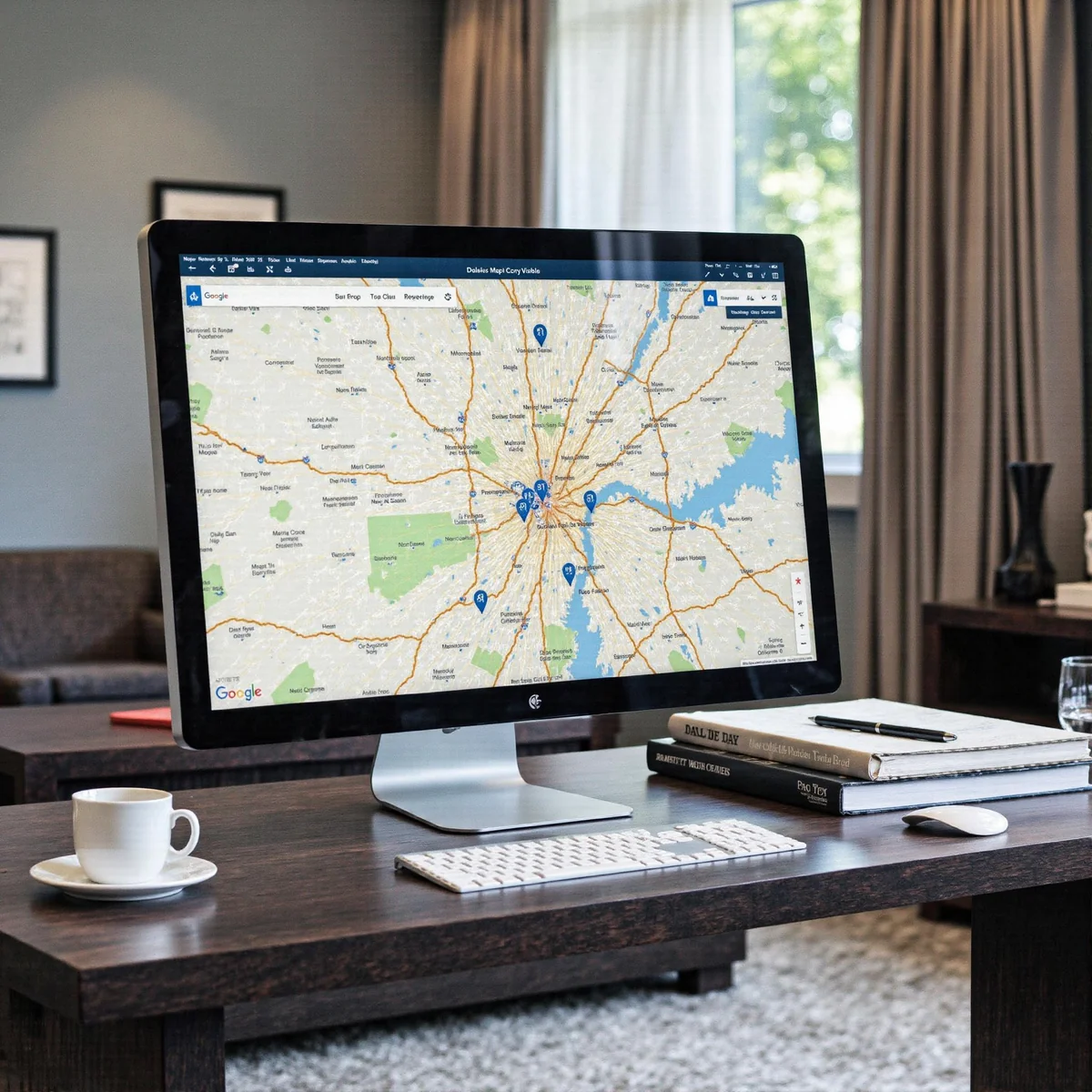
Used correctly, the profile becomes a compliance-friendly front door. It helps the right client recognize the right firm, while reducing the chances that your marketing language creates a bar issue later.
Turn Reviews, Reputation, and Client Feedback Into Local Authority
Reviews are one of the most visible trust signals in Maps. Google says reviews appear next to a Business Profile in Maps and Search and can help a business stand out. For a law firm, that matters because searchers often use reviews as a proxy for professionalism, responsiveness, and credibility. They are not perfect indicators of legal skill, but they are a strong signal that the firm has real client experience and a public reputation.
That said, law-firm review strategy has to be carefully managed. Google prohibits incentives for reviews, and verified businesses can reply publicly to reviews. That combination creates opportunity and risk. The opportunity is straightforward: a firm can ask for honest feedback after a resolved matter or a meaningful consultation, and it can use that feedback to reinforce trust. The risk is confidentiality. A reply that sounds helpful but mentions matter details, client identity, or case facts can create more problems than the review solved.
What to do next
The safest workflow is to make review requests voluntary, timely, and standardized. A firm can send a short request after a matter closes, after a client expresses satisfaction, or after a consultation where the prospect chose not to proceed but still had a positive experience. The request should be simple and should avoid pressure. If you use a link or QR code, keep the process frictionless. If you have multiple practice areas, review language should still be broad enough to avoid prompting clients to disclose sensitive information.
When a review appears, response discipline matters more than volume. A thank-you message should be courteous and generic. A complaint response should acknowledge the feedback without confirming representation details or discussing facts. Even if the reviewer seems to invite a full explanation, the safer posture is to stay high-level. That protects the firm, respects the client, and demonstrates professionalism to anyone reading the thread.
Reviews also help with prominence because they show recent activity and public engagement. The effect is not simply numerical. A firm with a steady stream of authentic reviews often appears more current and more established than one with an empty profile. In a competitive metro like Dallas, that can be enough to influence the click decision even when several firms appear in the same map pack.
In practical terms, reviews work best when they are part of a larger reputation system: consistent request timing, clear internal ownership, documented reply rules, and periodic audits to catch any statement that could be read as a confidentiality slip. When that system is in place, reviews become a durable local authority asset rather than an occasional marketing task.
Use Local Service Pages and ZIP-Code Content to Support Dallas County Visibility
A strong Business Profile cannot do all the work alone. The website still has to prove the geography, practice focus, and conversion readiness behind the listing. That is where local service pages and ZIP-code content come in. Google allows service areas to be set by city, ZIP code, or another area and says they should be specific and accurate. That makes Dallas County a natural organizing unit, with supporting pages for relevant ZIP codes such as 75201, 75202, 75203, 75204, and 75205, plus nearby Texas targets where the firm genuinely serves clients.
The goal is not to stuff the site with every ZIP code in Texas. The goal is to show a consistent local footprint. If your profile says Dallas and Dallas County, your website should echo that same local reality in the header tags, body copy, attorney bios, and contact pages. Google’s local system is looking for relevance, and a site that mirrors the profile gives it more confidence that the firm is a real option for that location.
What to do next
Local service pages work best when they are practical, not repetitive. A Dallas service page can explain office access, primary case types, nearby courts, and how consultations work. A ZIP-specific page can focus on the neighborhoods, commute patterns, and client concerns that matter in that area. Internal links should connect the office page, practice pages, attorney bios, and any location-specific content so the site architecture supports the same story the profile tells. That makes the experience easier for users and easier for search engines to interpret.
This section is also where conversion improves. A local visitor wants to know whether the firm actually handles their type of matter and whether the office feels accessible. Good local pages answer those questions directly. They make it easy to call, easy to request a consultation, and easy to see that the firm understands the local legal environment. That combination is especially important in legal services, where trust often depends on detail.
Another advantage of local content is that it supports your review and profile work. If a Dallas-area client reads a service page that matches the profile, then sees reviews that mention responsiveness and professionalism, the site feels coherent. That coherence is a ranking and conversion advantage. It also reduces the chance that a searcher lands on a page and wonders whether they reached the right firm.
In short, Dallas County visibility improves when the site and Maps listing act like two versions of the same local proof. The profile says where you are; the pages explain why that matters to the client.
Fix Intake, AI Use, and Confidentiality Workflows Before They Hurt Discovery
This is the part many firms are still catching up on. Public AI tools are no longer just a productivity issue. They are a privilege issue, a discovery issue, and an intake issue. Texas Ethics Opinion 705 warns that lawyers must be careful about revealing confidential client information to generative AI tools and that prompts can expose privileged mental impressions and confidential facts to the system. The opinion also emphasizes technological competence, verification of outputs, and the need to avoid putting confidential information at risk. In plain English: if your firm uses AI, it needs rules.
The biggest immediate risk is not a formal memorandum written by counsel; it is everyday behavior. A client pastes a sensitive fact into a public chat tool. A staff member tests a prompt with names, dates, or strategy. An intake team member uses AI to draft follow-up copy based on a real matter summary. Each of those actions can create issues if the tool stores or exposes the content. That is why intake scripts, website forms, and follow-up emails should include a clear warning not to submit sensitive facts through public AI chats.
What to do next
The internal policy should be equally practical. Define what tools are approved, what kinds of information can never be entered into public systems, who can use generative AI, how outputs must be reviewed, and where data may be stored. If the firm intends to use confidential information with a tool, the lawyer should be reasonably confident the provider will protect that information, and client consultation or consent may be needed. That is not merely a technical safeguard; it is a trust signal. Clients are increasingly aware that their own AI habits may affect their legal exposure, and they are looking for firms that understand the risk.
There is also a branding effect. A law firm that explains its confidentiality practices clearly tends to sound more reliable. That can improve conversion because prospects often equate operational discipline with legal competence. If your website, intake form, and staff scripts state that the firm does not want confidential facts dropped into public AI tools, you are protecting the client and demonstrating seriousness at the same time.
The practical connection back to Maps visibility is simple: trust converts search into action. If your profile looks accurate and your intake process looks safe, more people will contact the firm. If your front door appears sloppy or risky, people hesitate. In legal services, hesitation is expensive. A compliant AI policy, paired with a clear intake workflow, reduces that hesitation and gives your local visibility work a better chance of paying off.
A Practical Maps Visibility Checklist for Texas Law Firms
The strongest way to improve Maps visibility is to work in order. Start with the profile, then the reviews, then the local pages, then the intake rules. Trying to do everything at once usually produces inconsistent messaging. A staged checklist keeps the work focused and makes it easier to see which part of the funnel needs attention.
Here is the most practical sequence for a Texas firm that wants better Maps visibility without creating avoidable compliance risk:
How to reduce call friction
- Clean up the Google Business Profile name, category, phone, hours, address, service areas, and photos.
- Make sure the profile text does not promise outcomes, overstate specialties, or conflict with Texas advertising rules.
- Set a review-request workflow that is voluntary, timely, and free of incentives.
- Write review-response templates that avoid confidential facts and case-specific details.
- Build Dallas County and ZIP-code-specific service pages that match the same geography shown in Maps.
- Link office pages, attorney bios, and practice pages so the site supports the profile.
- Update intake forms and staff scripts to warn clients not to paste sensitive information into public AI tools.
- Adopt an internal AI-use policy covering approved tools, prompt use, storage, and review of outputs.
The checklist below shows how the highest-impact actions compare on visibility and risk:
| Priority | Action | Main benefit | Main risk if ignored |
|---|---|---|---|
| 1 | Profile cleanup | Immediate improvement in relevance and trust. | Mismatch, confusion, and misleading-profile exposure. |
| 2 | Review workflow | Stronger prominence and social proof. | Confidentiality mistakes or incentive violations. |
| 3 | Local service pages | Better geographic relevance for Dallas County and target ZIP codes. | Thin pages that fail to support the profile. |
| 4 | AI and intake policy | Lower privilege and discovery risk. | Sensitive facts entering public tools or unapproved systems. |
| 5 | Cross-channel consistency | Higher client confidence and cleaner conversion. | Searchers notice contradictions fast. |
If you want the most durable result, audit the profile, website, and compliance language together. That is the point where Maps visibility becomes a repeatable system rather than a one-time marketing task. For a Texas law firm, that system is what turns local search into qualified consultations without inviting preventable risk.
Frequently Asked Questions
How do Texas law firms improve Google Maps visibility without violating advertising rules? Use a truthful, verified Google Business Profile, keep the firm name and category aligned with real-world branding, and make sure the profile, website, and ads all match Texas advertising rules.
What should a Dallas law firm include in its Google Business Profile? Use the exact business name, the right primary category, a real office address if clients meet there, accurate phone and hours, approved service areas, and strong office and staff photos.
Do reviews still help attorney Maps rankings in Texas? Yes. Reviews still matter for trust and can support local prominence, but they must be genuine and handled without incentives or confidentiality mistakes.
How should a law firm handle client confidentiality in AI-powered intake workflows? Treat public AI tools as a risk point: warn clients not to paste sensitive facts into public chats, limit staff use to approved tools, and require verification and confidentiality safeguards.
What local SEO signals matter most for law firms serving Dallas County ZIP codes? The biggest levers are a complete and accurate Google Business Profile, the right category, consistent local service-area pages, reviews, and content that matches the same Dallas County geography across the site and profile.
Sources
- Google Business Profile Help: Tips to improve your local ranking on Google[1]
- Google Business Profile Help: Manage your service areas for service-area & hybrid businesses[3]
- Google Business Profile Help: Edit your Business Profile[4]
- Google Business Profile Help: Tips to get more reviews[5]
- State Bar of Texas: Texas Disciplinary Rules of Professional Conduct, Part VII: Information About Legal Services[6]
- State Bar of Texas: Ethics Opinion No. 705[7]