Dallas Law Firms: Mastering Local Search for Proven Lead Generation
Key sentence: In Dallas, a law firm’s digital footprint is its storefront – without strong local SEO and Google Maps visibility, even excellent attorneys can go unseen.
Key sentence: Local customers typically start their search on Google and expect up-to-date profiles with positive reviews; attorneys who optimize their presence win more trust and get more leads (www.texasbar.com[1]).
Key sentence: A high-converting website and proactive review strategy – aligned with Texas ethics rules – turns local search clicks into actual clients faster than broad marketing efforts.
Dallas law firms, like every small business, must integrate local SEO into their marketing playbook. This means being easily found on Google Maps, showing up in city-specific searches (e.g. “Dallas personal injury lawyer near me”), and converting traffic into contacts. Demand for legal help in Dallas (ZIP 75201–75205) and greater Texas metro areas (Houston 77001–77005, San Antonio 78201–78205, Austin 78701–78705, Lubbock 79401–79424) is high. Clients expect modern search habits – loading their nearest Google result and reading reviews – to yield trustworthy attorneys. Meeting that expectation requires a data-driven, multi-channel approach: on-site SEO, optimized Google Business profiles, cloud of local citations, and managed review strategy. This article maps out how Dallas firms can systematically boost local visibility and get more customers, using evidence-backed insights and checklist-driven tactics.
Local Search Reality for Texas Law Firms
Most potential clients in Dallas County and other Texas metros begin with a Google search on their smartphone. Studies show a majority of local searches result in a phone call or visit within a day (e.g. 70% of people who search for a local business act on that result). For law firms, this means having strong placement in Google’s local pack (the map-based listings) is crucial. In metropolitan areas like Dallas (Downtown 75201–75207, Oak Lawn 75219–75231) and Houston (Downtown 77002, Montrose 77006), search volume for practice areas is immense. Google’s algorithm prefers highly relevant, authoritative answers. Law firms must therefore appear in Google Business Profiles (GBP) with precise practice-area keywords and geo clues. Local SEO is no longer optional – it’s an expected part of _sm_ business marketing.
Dallas attorneys face stiff competition. Nearby counties (Dallas, Bexar, Harris, Travis, Lubbock, Hockley) house thousands of lawyers. A fractional ranking difference can mean thousands of missed weekly searches. For example, queries in ZIP 75204 (Deep Ellum/Arts District) and 75205 (Highland Park) often have dozens of law firms listed on Google Map 3-packs. Climbing into that top-3 local pack drives calls immeasurably more than ranking on page 2 of general search results. Winning the local pack is a multifaceted process: claims to the map listing must be complete (address, phone, business hours, categories, photos) and optimized regularly, because Google favors fully filled profiles. Without this, even a high-volume practice area like personal injury or family law will underperform relative to more attentive competitors.
For instance, after one Texas attorney updated his entire Google Business Profile with correct categories and pictures, he saw a spike in direction-clicks and calls, confirming the power of Google Maps presence. The Texas legal market is also sensitive to compliance: the Texas Center for Legal Ethics notes that lawyers may ask past clients to post positive reviews, but they must avoid improper inducements or misstatements (www.legalethicstexas.com[2]). One State Bar scenario illustrates this: a Texas lawyer set off alarms by having a client repeat a dubious “multi-million-dollar verdict” claim in reviews, which Texas ethics guides say should be corrected (www.texasbar.com[1]). This underscores that every review and profile update must be truthful and professional, not just a raw promotion.
Key takeaway: Dallas law firms must optimize local signals – from Google Business details to soliciting honest client reviews – to dominate city and ZIP-level search queries.
Building a Geo-Focused SEO Foundation
Every Dallas law firm’s website should be the hub of its digital presence. But just drawing traffic isn’t enough — the site must convert visitors into inquiries. Start with on-page SEO: ensure each major service (e.g. “Dallas criminal defense” or “Houston personal injury”) has a dedicated page with local keywords, clear meta titles, and useful FAQ content. Embed a Google Map on the Contact page to reinforce location. Modern Search Generative AI (including Google’s evolving RAG/Bard and ChatGPT-style results) often scans site content, so use structured data (schema.org) to mark up address, services, and attorney profiles. This helps with geo targeting and AEO (Answer Engine Optimization). For example, using Local Business or LegalService schema tags can signal to engines your geographic focus on Dallas and nearby cities.
Mobile optimization and speed are part of this foundation. Dallas customers often search on-the-go; Google’s Page Experience criteria mean that even desktop sites need to load quickly and clearly on mobile. If your site is slow or not mobile-friendly, you’ll lose potential clients – and Google will rank you lower. Prioritizing site performance is part of improving website conversion: visitors should be able to call or fill a contact form with one or two taps. Use clear callout elements (click-to-call buttons) and dedicated landing pages for each ZIP code region you serve. For example, firms serving Deep Ellum (75201–75204) to Oak Cliff (75203, 75215) might have pages highlighting those neighborhoods. Each page can be geo-optimized with area landmarks, Sample heading: “Serving Dallas, TX (75201–75205): Civil Litigation & Personal Injury”.
Finally, content strategy is critical. Firms should regularly publish articles or blog posts addressing client questions, changes in Texas law, or local success stories. These should include local keywords and schema (e.g. Attorney schema with biographies). Quality content establishes topical authority. Signal Strike’s approach (illustrated by a Texas case study) demonstrated that building a queue of relevant content can drive clicks upwards of 60% and improve average Google ranking positions significantly (www.linkedin.com[3]). Although that case was anonymized, it shows the power of semantically rich, location-focused content. Dublin’s same principle applies in Dallas: demonstrate expertise in Texas legal niches and match what clients actually search for (“truck accident lawsuit Texas” yields better contact forms if there’s detailed content on that city and Texas laws).
Key takeaway: Create a mobile-friendly, fast law firm website rich in local keywords and structured data. Regularly publish content answering Dallas-area legal questions to build authority and get more leads.
Google Business Profile and Review Strategy
“He encourages clients to post glowing reviews of his practice on as many platforms as they can.” (www.texasbar.com[4])
A verified Google Business Profile (GBP) is the centerpiece of local visibility. Ensure your Dallas firm’s GBP lists the correct address in ZIP 75201 (or your specific office), phone number, hours, and practice categories. High-quality photos (office, team, even law books) boost engagement. Dallas attorneys should periodically update posts or offers on their profile, as Google often highlights new updates in queries. The map listing should mirror your website NAP (Name, Address, Phone) exactly — inconsistent details confuse the algorithm and clients.
Generating and managing reviews on Google (and Bing/Yelp) is another critical piece. According to Texas’ ethics guidelines, you may encourage satisfied clients to leave honest reviews, but you must not promise any reward or fabricate comments (www.legalethicstexas.com[2]). In practice, this means politely asking clients for feedback or including a review request link after case closure. A steady stream of genuine five-star reviews improves credibility and ranking; Google notes that profiles with more (and more recent) reviews tend to rank higher on local queries. Always respond to reviews professionally, thanking clients and correcting any inaccuracies (as Texas rules imply (www.texasbar.com[1])). This response strategy signals to Google that you are an engaged business. Keep in mind: law firms cannot manipulate ratings (Texas Rule 7.07), so your focus should be on real, unsolicited client opinions to build trust.
Dallas’ competitive market means a few negative reviews can hurt. Handle them carefully: Texas ethics allows disputing a client comment if it’s false or misleading. However, many negative reviews are authentic experiences with dissatisfied clients – use them to show your firm’s responsiveness in public replies. In sum, treat your review strategy like legal practice: ethically, transparently, and with documentation. Encouraging online reviews is both a marketing play and a compliance checkpoint for Dallas attorneys (www.legalethicstexas.com[2]).
Key takeaway: Claim and optimize your Google Business Profile; actively seek and respond to genuine client reviews (following Texas ethics rules) to boost your firm’s perceived trust and local ranking.
Leveraging AI Trends and Voice Search (AEO/LLM SEO)
Search is rapidly evolving with AI. Google, Bing, and even ChatGPT-style apps now pull answers from the web and may display snippet-like responses to user queries. This trend, often called Answer Engine Optimization (AEO) or LLM SEO, requires law firms to format content as direct answers. For example, including a clear FAQ section (“How much does a Dallas lawyer cost?” “What to do if pulled over in Houston?”) can position your firm as the source of that quick answer. Dallas-based queries often include voice-phrases (“find a family lawyer in 75205”), so write naturally. AI assistants or voice search will rely on your structured content. While no official data is public yet, early SEO experts note that clear, conversational headings appear more often in AI-generated answer cards.
For geographic queries, voice engines emphasize known entities. Make sure your firm’s name is consistent across directories (Google My Business, Apple Maps, local lawyer associations) to help these AI tools confidently list you. In short, stay current with SEO best practices: keep definitions, headings, and location tags up-to-date. Incorporate your specialty and city into site titles and H-tags (e.g. “Dallas Divorce Attorney – [Your Firm Name]”) to feed AI relevance signals. This way, when a local user asks a voice assistant for a “Dallas business lawyer,” your firm has a higher chance of being cited.
Key takeaway: Adapt content for conversational queries. Use clear, concise answers (FAQs, natural language headings) so that AI-driven search assistants (Bing Chat, Google AI) list your firm prominently.
Data Insights: Tracking Local SEO Performance
Data is key to refining your local search visibility. Law firms should monitor metrics from Google Analytics and Google Business Insights. Track how many users find you through Dallas-area searches vs. other towns. Compare traffic from ZIP-specific campaigns. Also watch “Calls” and “Website Visits” from your GBP analytics – these show real leads. Over time, firms often see that website conversion from local searchers is higher than generic traffic, because users have immediate intent (“hire a lawyer now”). Quantify this: if 5% of clicks on your site become calls, that’s real ROI on your SEO spend.
Comparative data in Texas shows local competition. For example, if you rank #1 for “Dallas car accident lawyer”, competitors in Houston or San Antonio might be #3 in their area. Use tools (even free Google Trends) to gauge search interest peaks in each city’s metro. The goal is to expand where people look: an Austin PI firm might target Travis County searches, whereas a Lubbock firm works top 10 around 79401. Prioritize high-value terms (QN’s like “attorney near me”, “best [practice area] in Dallas”) and measure position changes. In practice, many firms see that appearing in Google’s 3-pack yields a click-through rate of 50–60%, far above standard organic positions. That means each rank improvement locally can dramatically increase actual inquiries – a key lever for growing your client list without raising ad spend.
Key takeaway: Regularly audit your SEO metrics. Track local search rankings and source of calls in your practice areas. Gradual improvements (even a 10–20% lift in clicks) translate to measurable gains in leads.
Actionable Playbook for Dallas Law Firms
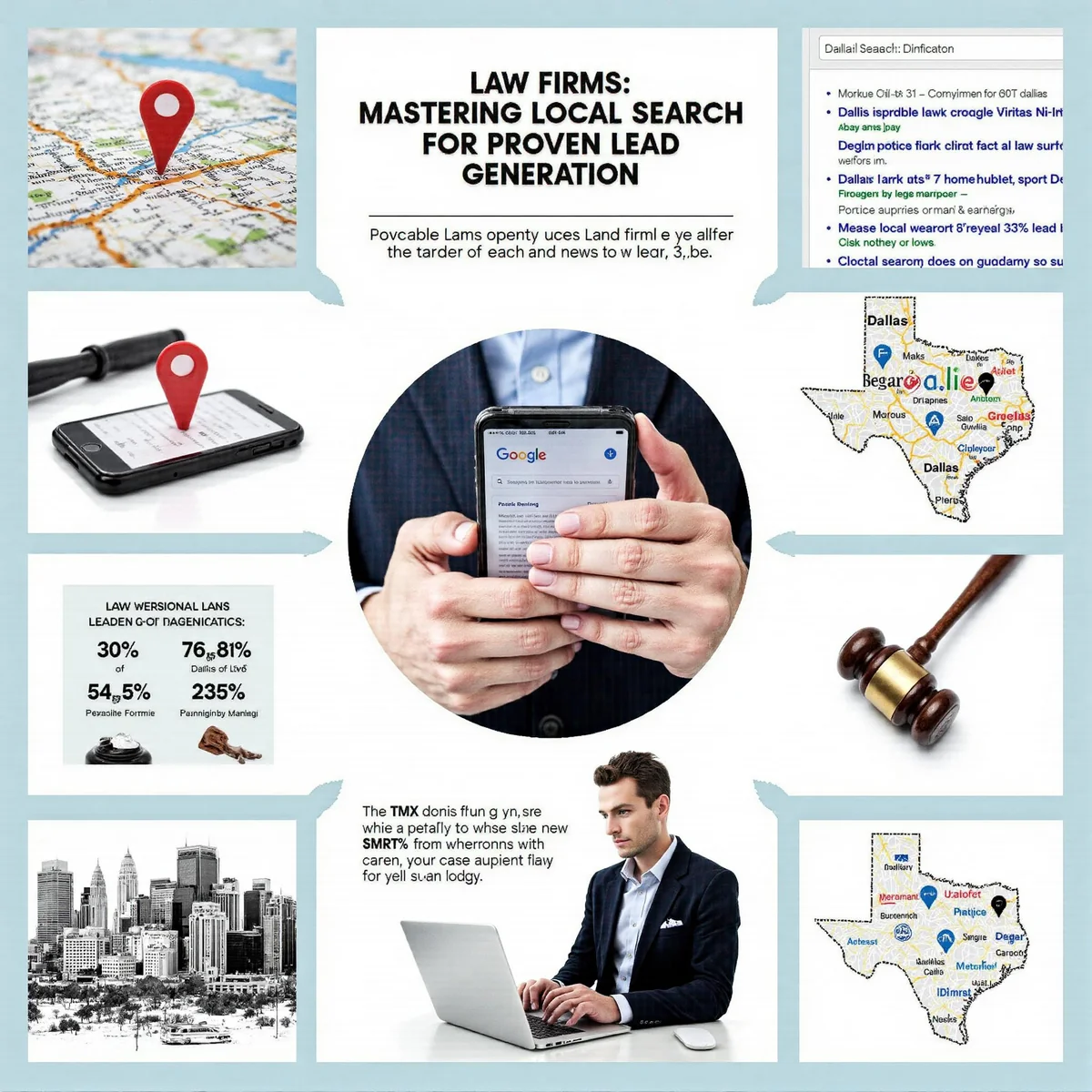
The map below provides a high-level summary of local marketing tactics for law firms:
| Strategy | Primary Focus | Why It Matters | Typical Timeline |
|---|---|---|---|
| Google Business Profile (Maps) | Claim & optimize your listing | Puts you in 3-pack; anchors local credibility | Updates immediate, ranking effect in weeks |
| On-Page Local SEO | Website landing pages with local keywords (e.g. “Dallas”), schema | Improves relevance for Dallas/Denton/Parker searches | 3–6 months for top rankings gains |
| Content & Blogging | Answer client questions, news, case studies | Builds topical authority and long-tail traffic | Ongoing; each new post takes weeks to rank |
| Online Reviews | Solicit and manage client reviews | Signals trust to Google and to prospects (www.legalethicstexas.com[2]) | Continuous; review count grows over months |
| Paid Ads (PPC) | Google Ads targeting Dallas zip codes | Immediate visibility, but costly per lead | Live as soon as launched (daily budgets) |
| Directories & Citations | Legal directories and relevant local sites | Build citations, NAP consistency, referral links | Setup in days; ranking benefit over months |
| AI/Voice Optimization | FAQ schema, answer-style content | Targets voice assistants and chat-based search | Integrate with content creation plan |
- Verify profiles across platforms: Claim your presence on Google, Bing, Yelp, legal directories (Avvo, Justia, Martindale) to ensure NAP consistency.
- Local citations: Ensure your firm is listed in local business associations (e.g. Dallas Bar Association member directory) and well-known local directories for law firms.
- Geo-targeted advertising: If using PPC, segment campaigns by city and even ZIP code. Compare contacts from downtown Dallas (75201) vs. outer suburbs to allocate budget efficiently.
- Conversion optimization: Use prominent call-to-actions (contact forms, click-to-call) on every page. Run A/B tests on headlines (e.g. “Dallas Auto Accident Lawyer – Free Consult”) to see which phrasing yields more submissions.
- Review monitoring: Use alerts or management tools to know instantly when a review is posted, so you can respond quickly. A response within 24 hours (even to praise) is seen positively by clients and algorithms alike.
Compliance and Quality Control
Law firm marketing isn’t typical advertising. Texas requires adherence to its professional conduct rules. Here’s how to keep compliant:
- Truthful advertising: Avoid exaggeration. If your Google profile or website claims “best in Dallas”, you could face ethical scrutiny. Stick to factual statements or client testimonials that are accurate and up-to-date (www.texasbar.com[1]).
- Review transparency: Do not remove or edit client reviews to manipulate appearance (unless they are demonstrably false). If a client wrote an inaccurate statement, a public correction or dispute might be necessary under disciplinary rules (www.texasbar.com[1]).
- Privacy law: If posting client stories or results on your site, redact personal info or get explicit consent, as required by Texas law.
- Local phone tracking: Use call tracking judiciously – it’s fine to use different numbers for ads vs. organic, but don’t sacrifice tracking client permissions for data.
- Professional conduct: Always prioritize user trust. Quality matters more than shortcuts. Local SEO gains are durable only when built on genuine reputation and service.
These compliance steps shouldn’t slow you down; instead, they guide your content and review efforts to ensure sustainability. For instance, before highlighting a “testimonial” on your site, double check accuracy – if necessary, phrase it as a client’s experience. In practice, operators in Dallas who follow both marketing best practices and Texas ethics find that their online leads turn into solid clients instead of complaints. For example, the Texas Center for Legal Ethics effectively sanctioned one lawyer who knowingly amplified a false review claim; by contrast, those who vet their promotional content upfront avoid sanctions and build trust (www.texasbar.com[1]).
Frequently Asked Questions
How soon should I implement local SEO tactics after opening my Dallas law practice?
A reputable Dallas law firm begins building its local presence immediately, even before seeking new clients. Set up your Google Business Profile and social pages as soon as you have an office address. Start by publishing basic service info on your website so search engines index it. Early action can yield meaningful results: law firms that claim their Google profile and optimize age–old often appear in relevant local searches within weeks. Delaying these steps only hands visibility to competitors actively targeting Dallas and nearby geo areas.
Can Texas attorneys ask clients for Google reviews?
Yes, Texas rules permit lawyers to invite current or former clients to leave honest reviews on platforms like Google or Yelp, as long as the lawyer does not pay or mislead anyone. The Texas Center for Legal Ethics explicitly addressed this, stipulating that lawyers may encourage “positive reviews or comments and favorable star ratings” from clients in a non-coercive way (www.legalethicstexas.com[2]). The key is authenticity: clients should freely express their real experience. Also ethically, you must promptly correct any known falsehood in those reviews (for example, if a client inaccurately states a case outcome, as discussed in Texas ethics guidance (www.texasbar.com[1])). Ensure your review request is professional (for instance, a follow-up email sharing a Google link) and track responses so you can manage them effectively.
What are “AEO” and “LLM SEO,” and do they matter for my Dallas law firm?
Answer Engine Optimization (AEO) and LLM SEO refer to optimizing for AI-driven search solutions (like Google’s AI answers or ChatGPT-style interfaces). Yes, they matter as search evolves. To optimize, focus on clear question-answer content. For example, include structured FAQ sections (Q&A style) addressing common client queries (“What does a personal injury lawyer do?” “How to file injury claim in Dallas?”). Short, authoritative answers and properly marked-up schema (FAQPage schema) can get your firm featured in AI-assisted answer boxes. This complements traditional SEO, because Google still relies on the same underlying content quality signals. By tuning your site and content for straightforward answers, you increase the chance AI platforms will surface your firm’s expertise when Dallas searchers ask voice assistants or chatbots for legal help.
Should I invest in pay-per-click (PPC) ads or focus on organic local SEO?
Both have roles, but organic local SEO often offers a better long-term investment. PPC ads (Google Ads, Bing Ads) can deliver immediate visibility—valuable if you need urgent leads or if your market is very new. However, Texas law firm CPCs (cost-per-click) are notoriously high in competitive cities like Dallas and Houston. In contrast, SEO (building organic rankings) has a delayed payoff but creates lasting presence at no ongoing cost per click. A balanced budget might use some PPC for top-tier keywords (“Dallas car accident lawyer near me”) while developing your organic profile through content and Google Maps optimization. Ultimately, Dallas firms with smaller budgets often focus on local SEO because it builds brand trust and accumulates equity, whereas PPC fluctuates with spend. Track which leads convert best for your firm: often local organic leads (searchers finding your site or map listing) are just as qualified as ad leads, but at lower cost per lead.
How important are local keywords (like ZIP codes) in my website and profiles?
Very important. Including city and ZIP references in your content and metadata signals relevance for local searches. For example, a Dallas firm might create pages or blog posts targeting “Dallas 75201 personal injury”, “Houston 77005 auto accident”, or “San Antonio 78204 DUI attorney”. When you mention neighborhoods (“Deep Ellum”, “River Oaks”) or major streets on your site, it can help search engines tie you to those areas. In practice, firms that optimize for each local market see better results in those markets. However, keep it natural and helpful – stuffing ZIP codes without context won’t fool search engines and may confuse readers. Instead, use them in headers, title tags, and the body where it adds local context. Tools like Google Ads Keyword Planner can show search volume by ZIP or city, which helps prioritize which local terms to target first.
Is there a difference between general SEO and local SEO for law firms?
Yes. General SEO focuses on improving visibility worldwide or nationally – good for brand authority. Local SEO specifically optimizes for users in a geographical area. For example, on-page local SEO might involve creating a page titled “Dallas Family Law Attorney – Serving 75201 and 75202” and adding schema that marks the business location. Mobile maps and “near me” queries are part of local SEO. For law firms in Dallas County or Travis County, local SEO means appearing in map searches when someone searches “lawyer near me” inside these zip codes. In contrast, a generic SEO approach might target broad terms like “best lawyer in Texas” which is highly competitive and less focused. For local client acquisition, Dallas firms should weigh heavy on local signals (Google Business, local citations, city names in content) alongside good general SEO practices like quality backlinks.
Sources