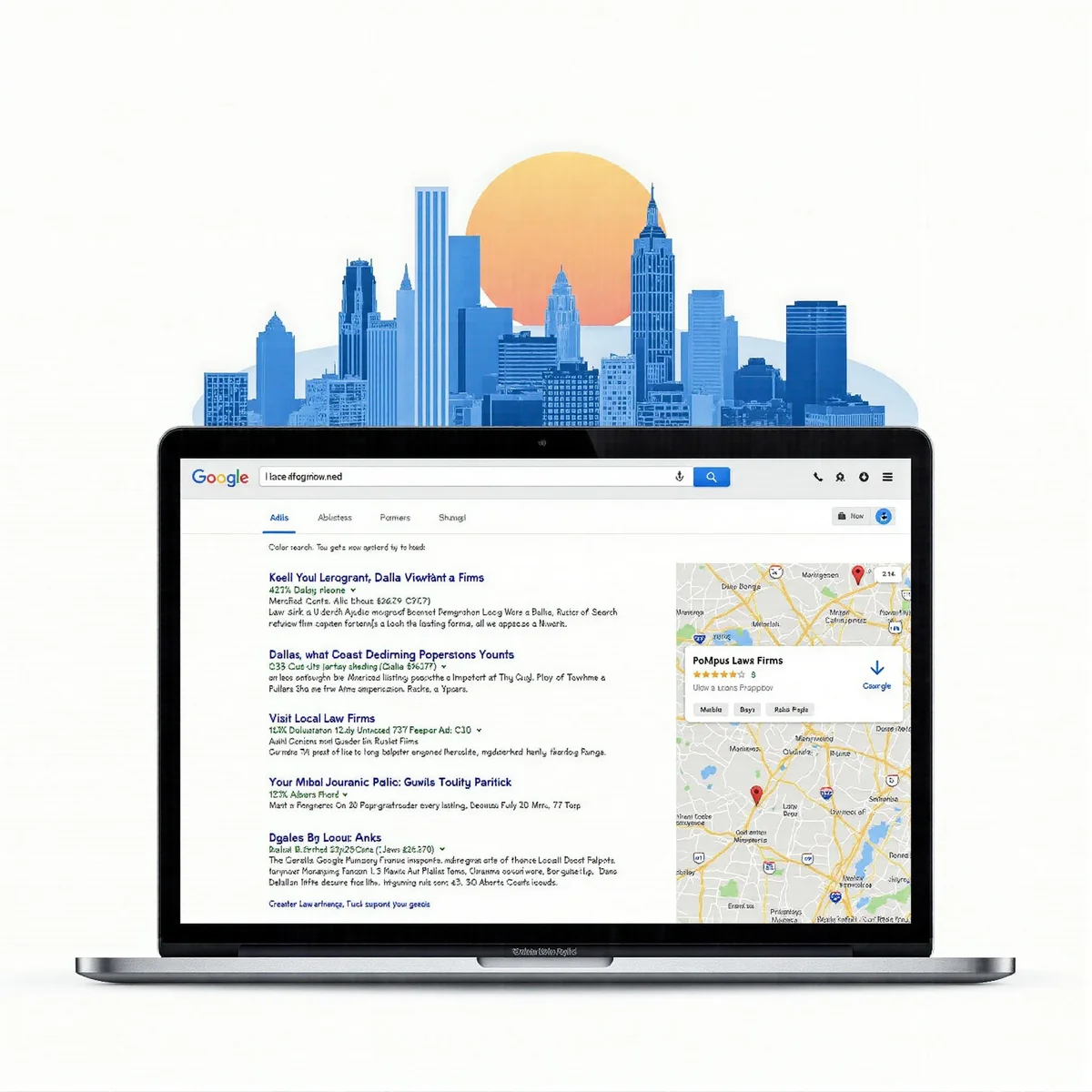
How Dallas Law Firms Achieve Proven Local Search Visibility
Key takeaway: Optimize your Google Business Profile and participate in small business marketing to ensure your law firm ranks high in local searches.
Key takeaway: Local search presence (especially on Google Maps) generates more leads and clients than general search branding aloneTexas Bar Knowledge Center[1].
Key takeaway: Claiming and verifying your Google Business Profile and choosing precise categories is crucial for local SEO impactTexas Bar Blog[2].
Key takeaway: A steady stream of positive client reviews on Google and other directories boosts trust and website conversion for lead generation.
Key takeaway: Create localized website content targeting Dallas neighborhoods and legal keywords to get more leads from search demand.
Key takeaway: Incorporate machine-learning tools (AI SEO, LLM SEO) to optimize answer content for ChatGPT visibility and local voice queries (AEO searches).
Strategic Overview: Local Search as Small Business Marketing
Dallas law firms operate in a competitive market and must treat their practice as a small business when building visibility. Local SEO is the marketing discipline that targets customers in a specific geographic area. For attorneys, this means aligning your website and online profiles to match what Dallas-area clients are searching for (e.g. “Dallas personal injury attorney” or queries including ZIP codes like 75205 or neighborhoods like Uptown). By focusing on local search optimization and Google Maps visibility, Dallas-based practices can get more leads and get more customers directly from search queries in their service areaTexas Bar Knowledge Center[1]Texas Bar Blog[2]. In effect, your online presence becomes a continuous lead generation engine rather than just a passive brochure.
Effective local marketing for law firms involves more than traditional advertising. It requires integrating website conversion best practices with offline trust signals. For example, a firm may invest in a modern website framework (mobile-friendly, fast-loading, secure) and also manage its reputation by collecting client reviews. Both technical optimization and social proof feed into local ranking algorithms. As one Texas attorney marketing expert notes, “Google Maps is STILL the #1 way potential clients find local attorneys”Texas Bar Knowledge Center[1]. In short, map pack visibility, combined with strong on-site and off-site SEO, forms the foundation of Dallas-local legal marketing.
Local Market Dynamics in Dallas and Beyond
Dallas County (including downtown Dallas ZIP codes like 75201–75205) has a dense concentration of law firms across practice areas – from personal injury to family law to corporate litigation. Even within Dallas’s central business district, clients search for lawyers on their phones or laptops with highly targeted queries. Nearby Texas metros (Houston’s 77002–77005, San Antonio’s 78201–78205, Austin’s 78701–78705, and Lubbock’s 79401–79424) follow similar local search trends. In each market, Google specializes results by location. For example, a “personal injury lawyer near me” search in Dallas might show different top firms than the same query in Austin.
These Texas metros share patterns: a majority of prospective clients will click on map-based results or the local pack rather than scroll past page 1. The Texas Bar’s marketing resources highlight that firms should expect over half their clicks to come from Google Business ProfilesTexas Bar Knowledge Center[1]. In practical terms, Dallas attorneys must actively manage their online business listings, compare themselves to nearby competitors, and use neighborhood-specific language. Content that mentions each target ZIP or community name signals to Google that you serve those clients. For example, a Dallas personal injury firm might create location-specific pages for “Uptown Dallas (75205)” or blog about cases near South Lamar (75215). This geographic relevance – often called a geo strategy – ensures your site resonates with local search demand and rises above national law firm directoriesTexas Bar Blog[2].
Small local steps like placing your firm’s address in schema markup and crafting location-targeted ad copy can make a big difference. Ultimately, by understanding Dallas-area user intent and search patterns, law firms turn local queries into inbound leads. The key is consistency: regularly update your GBP and website to reflect any changes in address, practice area, or team, so every outsearcher finds an accurate, credible profile. The result is a foundation of trust that feeds into lead generation and client acquisition.
Google Business Profile & Maps Optimization
Claim and verify your Google Business Profile (GBP) for each firm location – this is the first step. Enter your official law office name, address, phone, and hours, and choose precise categories (for example, Personal Injury Attorney or DWI/DUI Attorney). The Texas Bar notes that properly selected categories are among the top ranking factors for local law firmsTexas Bar Blog[2]. Add attributes (like appointment links) and post updates (e.g. recent cases won or staff milestones). Google rewards updated, accurate profiles with higher visibility.
- Complete Every Field: Fill in your business description, website, operating hours, and service list. According to Google’s guidelines, a thorough profile boosts trustGoogle Business Profile Help Center[3].
- Review Photos & Specialties: Upload professional office photos and headshots, and select specialties if available. Visual cues and specialty tags help clients find firms tailored to their needs.
- Enable Messaging & Q&A: Turn on messaging in GBP so clients can text you directly. Monitor and answer questions in the Q&A section promptly. Fast replies signal responsiveness to Google’s algorithms.
- Set Precise Categories: Make your core practice area (e.g. Family Law Attorney) the primary category. Additional categories (e.g. Mediation Services) can broaden search relevance. Choosing specific categories is critical for local rankingTexas Bar Blog[2].
“Google Maps is STILL the #1 way potential clients find local attorneys. (Google estimates that 50-80% of all search clicks are in the MAPS!)”[1]
For Dallas law firms, visual details on Maps matter too. Ensure you have a precise map marker for your office (the red pin on GBP). If you share space (e.g. inside a business complex), add suite numbers and clear signage photos. Encourage clients to check in or leave location-tagged photos when appropriate; these signals boost Google Maps visibility. Finally, double-check that your GBP’s service area covers your city — for example listing “Dallas, TX” and Dallas County neighborhoods — so that Google includes you in searches for relevant zip codes (75201, 75203, etc.).
Website & Content Strategy: Converting Visitors to Clients
Beyond your GBP, your website must convert local visitors into leads. Every local SEO click is an opportunity. Ensure your site prominently displays a phone number and click-to-call buttons for mobile users. Include a clear “Contact Us” form or live chat (depending on practice area). Dallas clients expect a responsive design and fast load times; a site audit can reveal optimization tasks. Use content that speaks Dallas geography – mention local courthouses (e.g. Frank Crowley Criminal Courts building) or Dallas neighborhoods (e.g. Oak Lawn). This reinforces local relevance.
On-Page SEO Essentials: In page titles and headers, combine practice areas with local terms. Examples: “Dallas Car Accident Lawyer – Uptown TX Attorneys” or “Dallas Divorce Attorney near 75205”. Create localized landing pages (e.g. “Dallas Family Law”, “Plano Personal Injury”). Embedding a Google Map of your location on the contact page also helps signals. SEO guides recommend targeting each locale with its own content sectionMoz – Beginner’s Guide to Local SEO[4].
Content & Questions: Law firms should publish blog posts or FAQs that answer specific Dallas-centric questions. For instance: “What to do after a car accident in Dallas” or “Dallas child custody laws.” Feature Dallas ZIP codes or landmarks in your articles to improve geo-targeting. Add a Q&A section styled for voice queries; modern SEO often optimizes for Answer Engine Optimization by providing direct answers. Structured content (headings, bullet lists, FAQs) helps search engines and AI assistants (like ChatGPT) pick out concise answers, boosting your ChatGPT visibility for local questions.
- Local Schema Markup: Add structured data (LocalBusiness, Attorney) on your site. This helps Google verify details like address and specialty. (See Google’s schema instructionsGoogle Business Profile Help Center[3].)
- Mobile First: Over half of local searches now come from smartphones. Use large buttons and easy navigation. A smooth mobile experience maximizes website conversion.
- Local Content Hubs: If your firm serves multiple Texas markets, maintain city-specific sections. For example, create a “Houston Estate Planning” page or an “Austin Bankruptcy Practice” page. These help capture queries in each specified ZIP code area.
Review Strategy and Reputation Management
Online reviews are a critical ranking and trust signal for legal services. A Texas Bar resource notes that “reviews on [Google Business Profile] are one of the top factors Google uses to rank your business listing.”[2] For Dallas law firms, a proactive review strategy means routinely asking satisfied clients to share their experience. Make it easy by sending a direct link to your Google reviews page after case resolution. Also certify profiles on legal directories like Avvo, Justia, and Yelp – these citations amplify credibility and sometimes appear in search results.
Local SEO rewards both the quantity and freshness of reviews. Aim to gather reviews regularly without spamming. Google tends to rank businesses with recent 4–5 star reviews higher in the local pack. Monitor negative feedback: respond professionally and promptly to showcase client care. Texas advertising rules mandate attorney communication be truthful; avoid incentivizing reviews with gifts. Focus instead on excellent service – genuine positive reviews will follow.
Citations & Trust: Ensure your Name-Address-Phone (NAP) is consistent across all major listings (Dallas Chamber directory, local BBB, Dallas Bar member list). Consistent NAP signals to Google that your Dallas office is legitimate. Verify your info on data aggregator sites (used by GPS apps) so mobile users see correct details. Merging any duplicate listings also consolidates reviews and rankings into one authoritative profile.
Advanced Strategies: AI, Voice Search and LLM SEO
The search landscape is shifting with voice assistants and AI models. People might ask Siri, Google Assistant or ChatGPT questions like “best Dallas DUI attorney” or “what to do after car accident Dallas TX.” Make sure your content answers these spoken queries in a natural way. Use conversational language in headers and paragraphs, and consider adding an FAQ section. These clear answers form the basis of Answer Engine Optimization (AEO), as voice assistants often read concise answers from your site.
AI Content Tools: Some law firms use AI tools (e.g. ChatGPT, Bard) to help draft local content. When using AI-generated text, always include local context (mention Dallas courts, Texas statutes, or Dallas news events) to differentiate from generic content. For instance, prompt ChatGPT with “Explain Dallas DUI laws” rather than a broad DUI overview. This helps your content resonate in ChatGPT answers. After generating drafts, refine them manually to ensure accuracy and authenticity.
Voice & Virtual Assistants: To capture voice-driven leads, prioritize short answers and local business details. If someone says “Hey Google, find a personal injury lawyer in Deep Ellum,” make sure your site or GBP listing includes those keywords. Additionally, test voice queries yourself: ask a smart assistant your target questions and see what sources it cites. Adjust your content to rank for those queries. This effort to improve ChatGPT visibility and voice search readiness keeps your firm competitive as AI plays a larger role in search.
| Channel | Lead Speed | Typical Cost | Notes |
|---|---|---|---|
| Google Maps & Organic SEO | Moderate (grows over weeks; often 50–80% of local search clicks[1]) | Low (content and time investment) | High ROI long-term; essential for visibility |
| Paid Ads (PPC/LSA) | Immediate | High (competitive legal CPC) | Generates instant leads; stops when budget ends |
| Referrals & Networking | Slow (case-by-case referrals) | Low | Strong trust impact; limited scale |
| Legal Directories (Avvo, Justia) | Slow-Moderate | Low to Moderate (some are paid) | Signals credibility; supplements GBP |

Actionable Checklist for Dallas Law Firms
- Claim & Verify: Claim your Dallas law office on Google Maps and verify it. Then fill out every profile field (description, categories, hours) to signal trust.
- Website Audit: Ensure all Dallas locations and practice areas are on your site. Confirm contact forms and click-to-call buttons work on desktop and mobile.
- Optimize Content: Use local keywords (including ZIP codes) in titles and headings. Update your blog and pages with Dallas-specific legal information.
- Gather Reviews: Systematically ask satisfied clients to post Google reviews. Try to earn a few new 5-star reviews each month to build momentum.
- Secure Local Listings: List your firm in Dallas business directories and legal associations. A link from a .edu or .org in Dallas can be very powerful.
- Monitor Performance: Track your local rankings, website traffic, and calls. Use Google Analytics and Search Console to see which Dallas queries bring visitors, and adjust focus accordingly.
- Leverage AI Tools: Try AI-powered SEO tools to analyze Dallas keyword gaps and to draft content ideas. Always human-edit AI outputs to include up-to-date Dallas context.
By following these steps, Dallas law firms put themselves on a path to more consistent client acquisition. Sales and marketing teams can treat local search like a pipeline: review it regularly, track leads back to search queries, and refine each element of your SEO funnel. Over time, investment in local SEO and reputation becomes one of your most reliable lead generation channels.
Frequently Asked Questions
How important is Google Maps visibility for a Dallas law firm?
Google Maps is extremely important. In fact, local searches for attorneys tend to click mostly on map-pack results【1†】. Ensuring your Dallas firm has a fully optimized Google Business Profile often drives more phone calls and site visits than remaining invisible on Maps. Claim your profile, pick the right categories, and keep it updated to capture this high-intent search traffic.
What steps improve lead generation in specific Dallas ZIP codes?
To target clients in Dallas ZIP codes (e.g. 75201–75205), create content and ads with those regions. Optimize site pages by including those ZIP codes in service-area mentions and on relevant landing pages. For example, mention “Dallas 75205” in blog titles when writing about neighborhood incidents. Also gather reviews from clients in those areas to boost rank, since Google interprets those signals as local relevance. Tracking which ZIP codes yield calls lets you adjust focus – double down on neighborhoods where local searches perform best.
Can a law firm use AI tools like ChatGPT for SEO?
Yes, but with care. AI tools like ChatGPT can help brainstorm content and answer FAQs, but the output needs human review. Focus prompts on Dallas context (for example, “Dallas family law attorney qualifications”). This yields location-specific text. Then refine it: fact-check legal details and add local touches. Good use of AI can speed up content creation while keeping the material relevant. Ultimately, Google values authentic expertise, so make sure your final content adds real value after the AI draft.
How do online reviews impact my Dallas firm’s search rankings?
Online reviews are a top ranking factor in local SEO【2†】. Google uses the number and quality of reviews in ranking local businesses. Consistently asking clients for Google reviews can boost your Dallas firm’s visibility. Each new positive review adds trust signals to Google’s algorithm.
Manage your reputation actively. Respond to reviews professionally. If you get a negative review, address it courteously – that can mitigate its impact. By steadily increasing high-star reviews, Dallas attorneys improve their Maps placement and encourage new potential clients to reach out.
What metrics should I track for local SEO success?
Track both search performance and actual inquiries. Use Google Analytics to measure traffic from local search terms, and Google Search Console to see your ranking keywords by city. Equally important: monitor leads from local search. Phone call tracking, contact form inquiries, or booking requests directly tied to Dallas-originating traffic give you real ROI data. Combine these metrics in a dashboard or spreadsheet. Regularly review which locales (ZIP codes) and keywords lead to the most conversions. That data tells you where to focus next.
Sources